


Personalized English Learning Platform Focused on Conversation
Personalized English Learning Platform Focused on Conversation
Learning English shouldn't mean choosing between grammar, vocabulary, or speaking.
Fluency Now is a personalized english learning platform designed to help busy adults build real speaking confidence through personalized learning paths, live conversation classes, podcasts, and spaced repetition.
Learning English shouldn't mean choosing between grammar, vocabulary, or speaking.
Fluency Now is a personalized english learning platform designed to help busy adults build real speaking confidence through personalized learning paths, live conversation classes, podcasts, and spaced repetition.
UX/UI Design • Figma • Strategy • Product Design
UX/UI Design • Figma • Strategy • Product Design
UX/UI Design • Figma • Strategy • Product Design
UX/UI Design • Figma • Strategy • Product Design
Personalized English Learning Platform Focused on Conversation
The Challenge
The Challenge
Many English learners spend years studying grammar and vocabulary but still struggle to communicate confidently.
Through UX Desk Research, I identified three recurring problems:
Adults have limited time to study.
Maintaining a consistent study routine is difficult.
Most learners lack opportunities to practice speaking.
I also observed that most learning platforms focus on only one aspect of language learning—grammar, vocabulary, or conversation—instead of combining them into a complete learning experience.
Many English learners spend years studying grammar and vocabulary but still struggle to communicate confidently.
Through UX Desk Research, I identified three recurring problems:
Adults have limited time to study.
Maintaining a consistent study routine is difficult.
Most learners lack opportunities to practice speaking.
I also observed that most learning platforms focus on only one aspect of language learning—grammar, vocabulary, or conversation—instead of combining them into a complete learning experience.
Many English learners spend years studying grammar and vocabulary but still struggle to communicate confidently.
Through UX Desk Research, I identified three recurring problems:
Adults have limited time to study.
Maintaining a consistent study routine is difficult.
Most learners lack opportunities to practice speaking.
I also observed that most learning platforms focus on only one aspect of language learning—grammar, vocabulary, or conversation—instead of combining them into a complete learning experience.
Research Method
Research Method
The research was conducted through UX Desk Research, analyzing discussions from online communities, forums, and social media where adult English learners shared their experiences. Based on recurring patterns, I created five personas representing the platform's primary users. The research revealed common challenges, including limited time to study, difficulty practicing speaking, fear of making mistakes, and low retention from passive learning. These insights guided the design of short, personalized learning paths with active speaking practice and features that encourage long-term consistency.
Many English learners spend years studying grammar and vocabulary but still struggle to communicate confidently.
Through UX Desk Research, I identified three recurring problems:
Adults have limited time to study.
Maintaining a consistent study routine is difficult.
Most learners lack opportunities to practice speaking.
I also observed that most learning platforms focus on only one aspect of language learning—grammar, vocabulary, or conversation—instead of combining them into a complete learning experience.
Many English learners spend years studying grammar and vocabulary but still struggle to communicate confidently.
Through UX Desk Research, I identified three recurring problems:
Adults have limited time to study.
Maintaining a consistent study routine is difficult.
Most learners lack opportunities to practice speaking.
I also observed that most learning platforms focus on only one aspect of language learning—grammar, vocabulary, or conversation—instead of combining them into a complete learning experience.
Persona 1 — Lucas, 29
Occupation: Marketing Professional
Background
Lucas completed two years of English classes but still struggles to communicate confidently.Goals
Speak naturally during meetings.
Feel comfortable using English at work.
Build confidence in conversations.
Pain Points
Classes focused mostly on grammar.
Freezes when speaking.
Afraid of making mistakes.
Needs
More real speaking practice.
Practical conversations.
Confidence-building exercises.
Persona 2 — Amanda, 22
Occupation: University Student
Background
Amanda understands basic English but overthinks every sentence before speaking.Goals
Speak more naturally.
Gain confidence.
Stop translating mentally.
Pain Points
Fear of speaking incorrectly.
Speaks very slowly.
Anxiety during conversations.
Needs
A judgment-free environment.
Frequent speaking practice.
Short daily exercises.
Persona 3 — Rafael, 34
Occupation: Project Manager
Background
Rafael works full-time and only has 20–30 minutes available for studying each day.Goals
Stay consistent.
Improve English without changing his routine.
Learn efficiently.
Pain Points
Long lessons.
Lack of time.
Difficulty maintaining consistency.
Needs
Short learning sessions.
Flexible schedule.
Daily learning habit.
Persona 4 — Fernanda, 31
Occupation: Software Developer
Background
Fernanda can understand movies and articles but rarely speaks English.Goals
Become fluent in conversation.
Practice speaking regularly.
Improve pronunciation.
Pain Points
Never had someone to practice with.
Understands more than she can express.
Low confidence.
Needs
Live conversation practice.
Speaking-first methodology.
Frequent exposure to spoken English.
Persona 5 — Bruno, 27
Occupation: Graphic Designer
Background
Bruno has used several language-learning apps but never became conversational.Goals
Use English naturally.
Apply vocabulary in real situations.
Learn beyond isolated words.
Pain Points
Memorizes vocabulary without context.
Passive learning.
Low retention.
Needs
Context-based learning.
Real-life examples.
Active recall.
Persona 1 — Lucas, 29
Occupation: Marketing Professional
Background
Lucas completed two years of English classes but still struggles to communicate confidently.Goals
Speak naturally during meetings.
Feel comfortable using English at work.
Build confidence in conversations.
Pain Points
Classes focused mostly on grammar.
Freezes when speaking.
Afraid of making mistakes.
Needs
More real speaking practice.
Practical conversations.
Confidence-building exercises.
Persona 2 — Amanda, 22
Occupation: University Student
Background
Amanda understands basic English but overthinks every sentence before speaking.Goals
Speak more naturally.
Gain confidence.
Stop translating mentally.
Pain Points
Fear of speaking incorrectly.
Speaks very slowly.
Anxiety during conversations.
Needs
A judgment-free environment.
Frequent speaking practice.
Short daily exercises.
Persona 3 — Rafael, 34
Occupation: Project Manager
Background
Rafael works full-time and only has 20–30 minutes available for studying each day.Goals
Stay consistent.
Improve English without changing his routine.
Learn efficiently.
Pain Points
Long lessons.
Lack of time.
Difficulty maintaining consistency.
Needs
Short learning sessions.
Flexible schedule.
Daily learning habit.
Persona 4 — Fernanda, 31
Occupation: Software Developer
Background
Fernanda can understand movies and articles but rarely speaks English.Goals
Become fluent in conversation.
Practice speaking regularly.
Improve pronunciation.
Pain Points
Never had someone to practice with.
Understands more than she can express.
Low confidence.
Needs
Live conversation practice.
Speaking-first methodology.
Frequent exposure to spoken English.
Persona 5 — Bruno, 27
Occupation: Graphic Designer
Background
Bruno has used several language-learning apps but never became conversational.Goals
Use English naturally.
Apply vocabulary in real situations.
Learn beyond isolated words.
Pain Points
Memorizes vocabulary without context.
Passive learning.
Low retention.
Needs
Context-based learning.
Real-life examples.
Active recall.
Wireframes
Wireframes
Wireframes

Home Dashboard
Home Dashboard
Home Dashboard
The Home Dashboard was designed to give learners quick access to the platform's core features while reducing cognitive load. Instead of navigating through multiple pages, students can access their personalized learning journey, schedule conversation classes, continue their immersion practice, and track their study consistency from a single screen.
Many English learners spend years studying grammar and vocabulary but still struggle to communicate confidently.
Through UX Desk Research, I identified three recurring problems:
Adults have limited time to study.
Maintaining a consistent study routine is difficult.
Most learners lack opportunities to practice speaking.
I also observed that most learning platforms focus on only one aspect of language learning—grammar, vocabulary, or conversation—instead of combining them into a complete learning experience.
Many English learners spend years studying grammar and vocabulary but still struggle to communicate confidently.
Through UX Desk Research, I identified three recurring problems:
Adults have limited time to study.
Maintaining a consistent study routine is difficult.
Most learners lack opportunities to practice speaking.
I also observed that most learning platforms focus on only one aspect of language learning—grammar, vocabulary, or conversation—instead of combining them into a complete learning experience.

Personalized Learning Path
Personalized Learning Path
The main banner highlights the student's selected learning path—Business English, Real-Life English, or Academic English—allowing them to quickly continue where they left off. Prioritizing the personalized course reinforces the user's primary learning goal and reduces friction when resuming their studies.
Many English learners spend years studying grammar and vocabulary but still struggle to communicate confidently.
Through UX Desk Research, I identified three recurring problems:
Adults have limited time to study.
Maintaining a consistent study routine is difficult.
Most learners lack opportunities to practice speaking.
I also observed that most learning platforms focus on only one aspect of language learning—grammar, vocabulary, or conversation—instead of combining them into a complete learning experience.
Many English learners spend years studying grammar and vocabulary but still struggle to communicate confidently.
Through UX Desk Research, I identified three recurring problems:
Adults have limited time to study.
Maintaining a consistent study routine is difficult.
Most learners lack opportunities to practice speaking.
I also observed that most learning platforms focus on only one aspect of language learning—grammar, vocabulary, or conversation—instead of combining them into a complete learning experience.
Daily Study Streak
Daily Study Streak
To encourage consistent learning, I designed a Daily Streak system that rewards learners for completing their daily study goals. Each completed day increases their streak, helping build a sustainable learning habit.
A dedicated overlay displays the current streak, longest streak, study calendar, and the remaining days until the next reward, providing clear progress tracking and daily motivation.
After 30 consecutive study days, learners earn a free one-on-one conversation class credit, encouraging long-term engagement while reinforcing the platform's goal of improving speaking confidence through consistent practice.
To encourage consistent learning, I designed a Daily Streak system that rewards learners for completing their daily study goals. Each completed day increases their streak, helping build a sustainable learning habit.
A dedicated overlay displays the current streak, longest streak, study calendar, and the remaining days until the next reward, providing clear progress tracking and daily motivation.
After 30 consecutive study days, learners earn a free one-on-one conversation class credit, encouraging long-term engagement while reinforcing the platform's goal of improving speaking confidence through consistent practice.

Conversation Class Scheduling
Conversation Class Scheduling
Conversation Class Scheduling
The dashboard includes an integrated scheduling system where learners can choose the date, time, English proficiency level, and class format (group or one-on-one) for live conversation sessions. Once scheduled, classes automatically appear in the Your Classes section, helping learners stay organized and quickly access upcoming sessions.
The platform also features a credit system: students receive one group conversation class credit per week with their subscription, while completing 30 consecutive study days unlocks a free one-on-one conversation class. This rewards consistency and encourages long-term engagement.
The dashboard includes an integrated scheduling system where learners can choose the date, time, English proficiency level, and class format (group or one-on-one) for live conversation sessions. Once scheduled, classes automatically appear in the Your Classes section, helping learners stay organized and quickly access upcoming sessions.
The platform also features a credit system: students receive one group conversation class credit per week with their subscription, while completing 30 consecutive study days unlocks a free one-on-one conversation class. This rewards consistency and encourages long-term engagement.


Immersion Area
Immersion Area
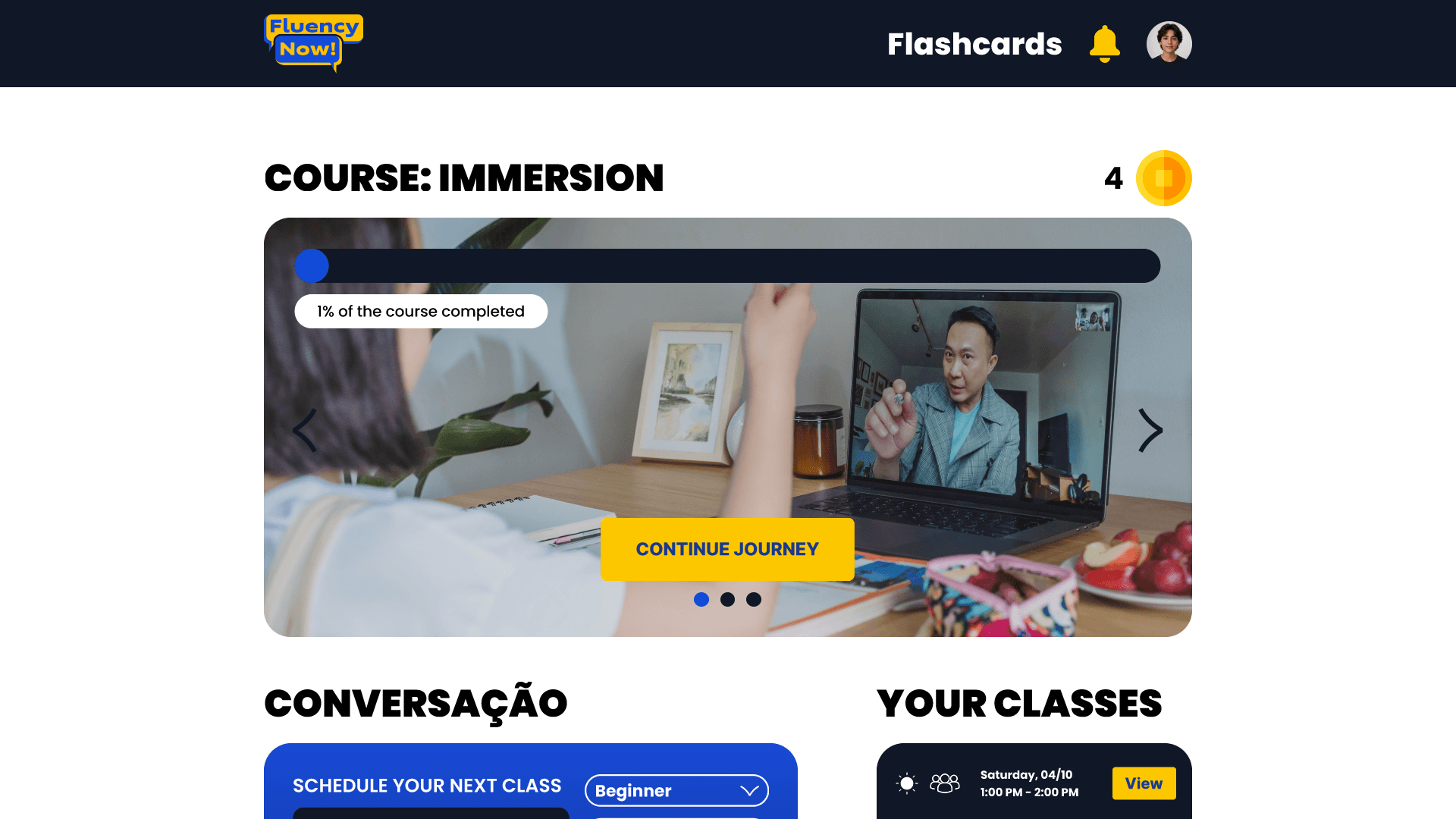
To reinforce learning beyond structured lessons, I designed an Immersion Area with podcast episodes organized into modules. Each episode lasts approximately 15 minutes, making it easy for busy learners to fit listening practice into their daily routine.
Completed episodes use a different visual style, while the next recommended lesson is highlighted with a "Continue Here" indicator, helping learners quickly identify where to resume their progress.
Combined with the module selector and course progress bar, these visual cues reduce cognitive load, keep learners organized, and encourage consistent study habits throughout the immersion journey.
To reinforce learning beyond structured lessons, I designed an Immersion Area with podcast episodes organized into modules. Each episode lasts approximately 15 minutes, making it easy for busy learners to fit listening practice into their daily routine.
Completed episodes use a different visual style, while the next recommended lesson is highlighted with a "Continue Here" indicator, helping learners quickly identify where to resume their progress.
Combined with the module selector and course progress bar, these visual cues reduce cognitive load, keep learners organized, and encourage consistent study habits throughout the immersion journey.

Learning Courses
Learning Courses
Learning Courses
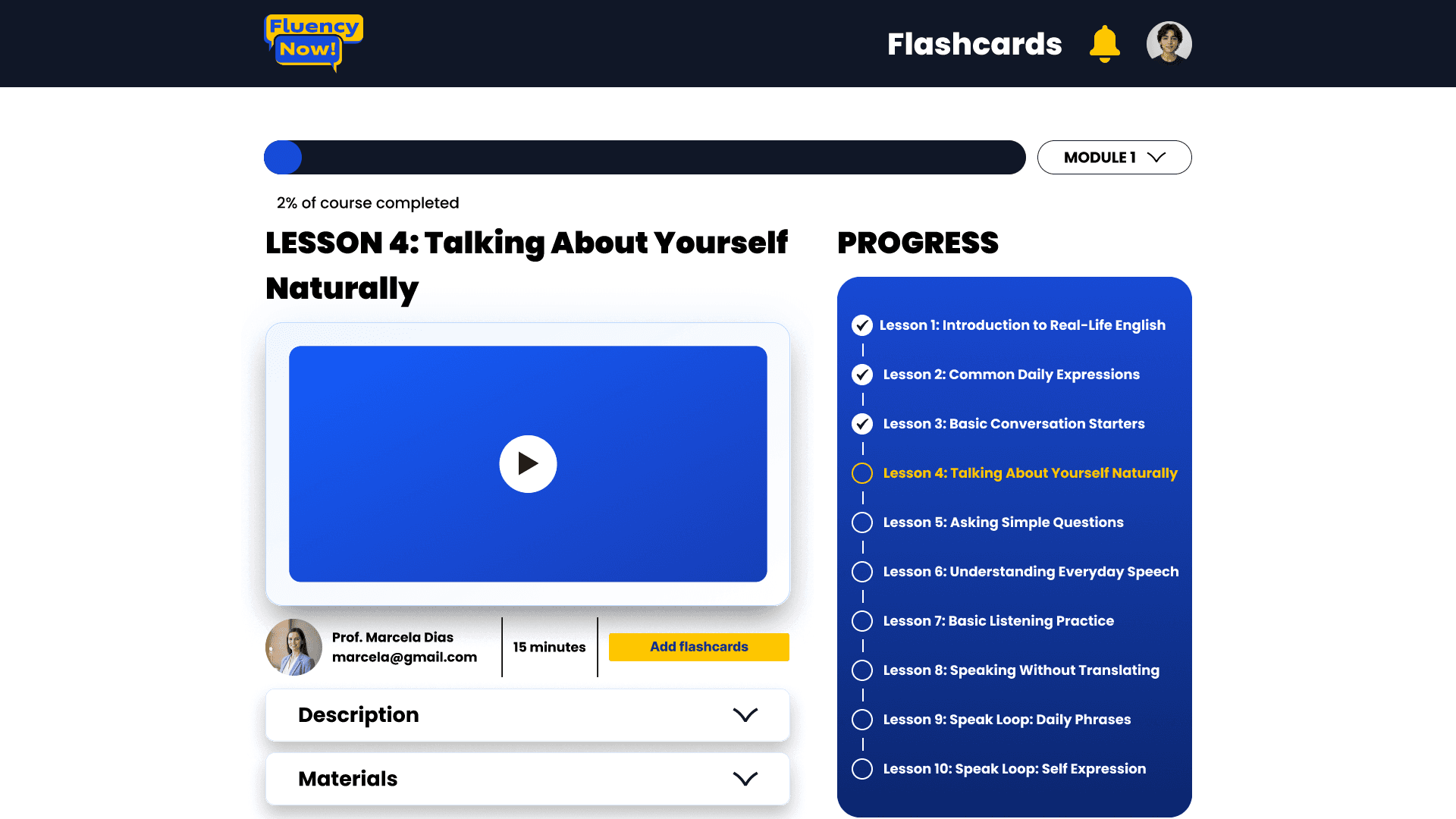
The course experience was designed to provide a clear and motivating learning journey while fitting into learners' busy schedules. Lessons are organized into modules and last approximately 15 minutes, making daily study more manageable and encouraging consistency.
A visible progress panel helps learners track their course, with completed lessons marked by a checkmark and the current lesson highlighted, making it easy to know where to continue. An overall progress bar further reinforces motivation by showing course completion.
After each lesson, learners can add key expressions to their flashcard library, creating a seamless transition from learning to active recall through spaced repetition and speaking practice.
The course experience was designed to provide a clear and motivating learning journey while fitting into learners' busy schedules. Lessons are organized into modules and last approximately 15 minutes, making daily study more manageable and encouraging consistency.
A visible progress panel helps learners track their course, with completed lessons marked by a checkmark and the current lesson highlighted, making it easy to know where to continue. An overall progress bar further reinforces motivation by showing course completion.
After each lesson, learners can add key expressions to their flashcard library, creating a seamless transition from learning to active recall through spaced repetition and speaking practice.
Spaced Repetition Flashcards
Spaced Repetition Flashcards
To improve long-term retention and speaking confidence, I redesigned the traditional flashcard experience around active recall instead of passive memorization.
Each flashcard displays an English sentence with its phonetic transcription, encouraging learners to say it out loud before revealing a simple English explanation and listening to the correct pronunciation.
Learners then rate their performance as Easy, Medium, Hard, or I got it wrong. These ratings power the spaced repetition system, showing difficult flashcards more often while reducing the frequency of mastered ones. This creates a personalized review experience that reinforces speaking, pronunciation, and long-term retention.
To improve long-term retention and speaking confidence, I redesigned the traditional flashcard experience around active recall instead of passive memorization.
Each flashcard displays an English sentence with its phonetic transcription, encouraging learners to say it out loud before revealing a simple English explanation and listening to the correct pronunciation.
Learners then rate their performance as Easy, Medium, Hard, or I got it wrong. These ratings power the spaced repetition system, showing difficult flashcards more often while reducing the frequency of mastered ones. This creates a personalized review experience that reinforces speaking, pronunciation, and long-term retention.


Lesson Completion & Progress Feedback
Lesson Completion & Progress Feedback
To reinforce consistency and create a rewarding experience, I designed a Lesson Completion screen that celebrates every study session and provides immediate feedback on learners' progress.
After each lesson, learners see a summary of their achievements, including flashcards completed, lessons finished, study time, and their updated Daily Streak, encouraging them to maintain their learning routine.
The screen also highlights how many consecutive study days remain until the next reward—a free one-on-one conversation class—and displays a visual calendar to make progress easy to track. Finally, the Continue button provides a clear next step, helping learners maintain momentum throughout their learning journey.
To reinforce consistency and create a rewarding experience, I designed a Lesson Completion screen that celebrates every study session and provides immediate feedback on learners' progress.
After each lesson, learners see a summary of their achievements, including flashcards completed, lessons finished, study time, and their updated Daily Streak, encouraging them to maintain their learning routine.
The screen also highlights how many consecutive study days remain until the next reward—a free one-on-one conversation class—and displays a visual calendar to make progress easy to track. Finally, the Continue button provides a clear next step, helping learners maintain momentum throughout their learning journey.

Prototype
Prototype
High-Converting Landing Page
High-Converting Landing Page
This landing page was designed with a clear goal: maximize course conversions by guiding visitors from identifying their problem to confidently enrolling in the program.
The page follows a persuasive structure that highlights learners' pain points, presents the Fluency Now method, showcases its key benefits, explains how the learning experience works, builds trust through testimonials and guarantees, and reinforces the value of the offer with multiple call-to-action sections. Every element was designed to reduce hesitation and support informed purchase decisions.
This landing page was designed with a clear goal: maximize course conversions by guiding visitors from identifying their problem to confidently enrolling in the program.
The page follows a persuasive structure that highlights learners' pain points, presents the Fluency Now method, showcases its key benefits, explains how the learning experience works, builds trust through testimonials and guarantees, and reinforces the value of the offer with multiple call-to-action sections. Every element was designed to reduce hesitation and support informed purchase decisions.
Expected Results
Expected Results
As Fluency Now is a fictional product created as a Product Design case study, no usability testing or real user metrics have been collected yet. The expected outcomes are based on insights gathered during the UX Desk Research and the design decisions made throughout the project.
The proposed solution aims to:
Increase learners' speaking confidence through frequent conversation practice.
Help busy adults maintain a consistent study routine with short, flexible lessons.
Improve long-term retention through a speaking-first spaced repetition system.
Create a more personalized learning experience based on each student's goals.
Encourage long-term engagement through gamification, progress tracking, and rewards.
As Fluency Now is a fictional product created as a Product Design case study, no usability testing or real user metrics have been collected yet. The expected outcomes are based on insights gathered during the UX Desk Research and the design decisions made throughout the project.
The proposed solution aims to:
Increase learners' speaking confidence through frequent conversation practice.
Help busy adults maintain a consistent study routine with short, flexible lessons.
Improve long-term retention through a speaking-first spaced repetition system.
Create a more personalized learning experience based on each student's goals.
Encourage long-term engagement through gamification, progress tracking, and rewards.
Partnership
Partnership

Emanuele Araújo - Manuillustra
Emanuele Araújo - Manuillustra
I was responsible for the entire Product Design process, including UX Desk Research, product strategy, information architecture, user flows, wireframes, UI design, interaction design, and the interactive prototype.
I was responsible for the entire Product Design process, including UX Desk Research, product strategy, information architecture, user flows, wireframes, UI design, interaction design, and the interactive prototype.

Matheus - Designer Atípico
Matheus - Designer Atípico
Matheus (Designer Atípico) was responsible for the visual identity, creating the logo, color palette, and typography, as well as editing the prototype presentation videos.
Matheus (Designer Atípico) was responsible for the visual identity, creating the logo, color palette, and typography, as well as editing the prototype presentation videos.
Insights
Insights
Fluency Now allowed me to explore the complete Product Design process—from UX Desk Research to information architecture, user flows, wireframes, visual design, interaction design, and prototyping. The project strengthened my ability to transform research insights into a cohesive learning experience focused on personalization, active practice, and long-term engagement.
Fluency Now allowed me to explore the complete Product Design process—from UX Desk Research to information architecture, user flows, wireframes, visual design, interaction design, and prototyping. The project strengthened my ability to transform research insights into a cohesive learning experience focused on personalization, active practice, and long-term engagement.
Software
Software
Software

Interested in my work? Inquiries and quotes:
manuillustra@gmail.com
Interested in my work?
Inquiries and quotes:
manuillustra@gmail.com
Interested in my work? Inquiries and quotes:
manuillustra@gmail.com
Interested in my work? Inquiries and quotes:
manuillustra@gmail.com
©2026 Manuillustra. all rights reserved.
©2026 Manuillustra. all rights reserved.
©2026 Manuillustra. all rights reserved.
©2026 Manuillustra. all rights reserved.